

What is the right level of warmth for you? Our guide answers questions and helps you choose your next jacket
As soon as temperatures drop slightly after summer, discussions break out everywhere.... what is actually warm, what is cold? At the start of the heating season, people argue passionately about why either the window should be open all night, or the indoor temperature should ideally resemble a Finnish steam sauna. Because, as we all know: what we perceive as "warm" or "cold" is very subjective and dependent on the situation.
But how do you decide on the right level of warmth for your new autumn and winter jacket? This little guide is intended to help, clear up a few myths, and give you as many facts as possible to help you feel comfortably warm in your new jacket.
First, a little about us. Because advice is also about trust. How can you assess or judge a jacket that you have never worn, let alone been able to test for a whole season? That is where we come in. We have been selling several of our jacket brands, or brands that offer outerwear, such as Didriksons and Elvine, for over 10 years. During this time, we have seen some technical innovations, learned from misjudgments, and have been able to draw on a large pool of feedback from our customers, who help us continuously improve our advice with their feedback. Other labels that have not been available with us for as long, such as the Munich-based brand LangerChen, are in close contact with us and never hesitate to provide information or clarify the features and innovations of their jackets, as well as listen to feedback from buyers. That is why if you have any questions, please do not hesitate to contact our trained staff; together we will find the perfect jacket for you.
Now, about you: together we will find out what it is that you are looking for and need? We will ask you a few questions, you will tell us what you are looking for, and we will show you our selection. Roughly speaking, three categories of warmth levels can be distinguished:
1. Unlined and lightly lined jackets
These jackets have no sewn-in padding or lining. This includes classic rain jackets or blousons. However, when combined with another insulating layer, such as fleece or a thick wool sweater, these jackets can also offer a certain amount of warmth, as they are often wind- and waterproof, thus retaining your body heat inside the jacket and shielding your body from the cold wind. These jackets are not suitable for the deepest and coldest winter days. However, they are lightweight and easy to store, and can be used for a variety of purposes using the layering principle.
However, in spring and summer, they are the first choice as soon as temperatures have risen above freezing. They are excellent for layering and styling. They do not feel too heavy, but offer enough protection on cool spring evenings.
2. Lightly lined and medium-lined jackets
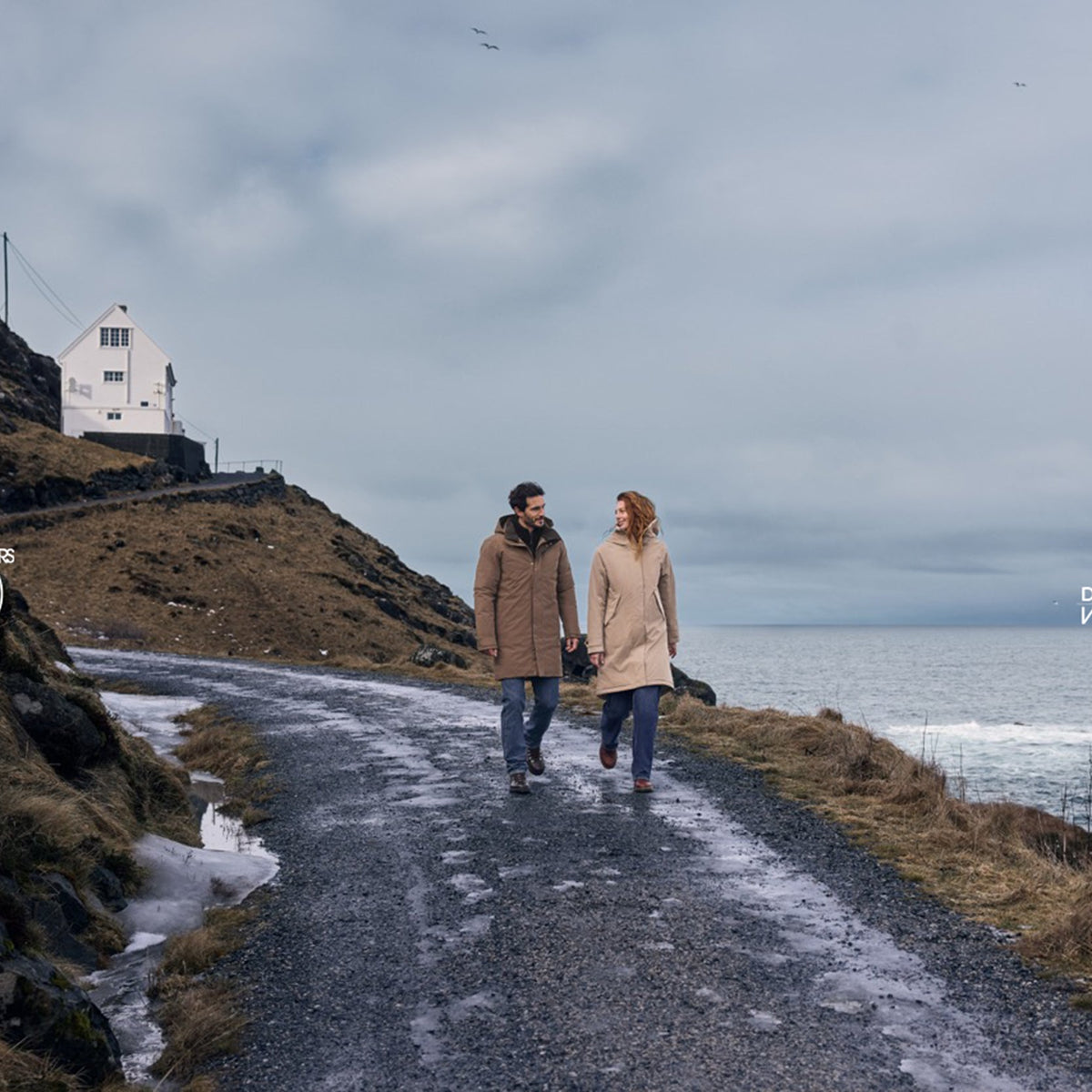
These jackets are better suited for the biting wet cold of the north in late autumn and early winter. Most have padding between 100 - 150 g/m2 and are, at best, wind- and waterproof. Taped seams and a design intended to retain as much warmth as possible inside the jacket, such as storm hoods or cuffs, ensure good insulation and reliably protect against the elements. With a suitable layering system underneath, these lightweight jackets can either be used with thin layers for cycling or other activities without overheating or restricting movement, or made winter-ready with long-sleeved base layers, wool sweaters, scarves, and hats. This level is sufficient for the majority of users and use cases.
Alternatively, this category also includes jackets that have some lining but were not primarily designed to withstand rain and wind. Think of workwear or Harrington jackets with wool lining or quilted padding. They offer more warmth than classic rain shells or unlined cotton jackets, but are more intended for the transitional periods at the end of winter and end of autumn, for evenings that are still crisp and cold in early March, or sunny October mornings.
But for those for whom it can never be warm enough...
...there is still the third level. Here you will find thickly padded jackets that are often longer and thus wrap almost the entire body in a comfortably warm insulating layer. The padding is then often between 150 - 250 g/m2. All the previously mentioned features such as wind- and waterproofness, hoods, or handwarmer pockets often apply here too. These jackets are usually heavier due to their increased fill and length. In return, they protect against the biting cold even when standing still, making them ideal for users who spend a long time outdoors without being very physically active and thus cannot generate much body heat (for example, with the children on the playground, at football practice, or at a Christmas market where you stand around a lot).
For all these categories, there are of course hybrids that have certain features but not others. That is where we come in and advise you.
Just a little information for all buyers who value sustainability: many of our jackets are made using sustainable methods and recycled materials. For more information, feel free to visit our Sustainability Blog.
Unless otherwise indicated, all jackets in our selection are equipped with synthetic fillings and are down-free.