A fabric for eternity
There are few things as iconic as jeans. Hardly any other item of clothing, no, hardly any other item, has held a firm place in our society and collective consciousness for so many decades, and has touched, enlivened, and enriched so many cultures and subcultures as the famous cotton fabric denim.
Originally developed as workwear for gold prospectors at the end of the 19th century, jeans and denim twill became the clothing of the hardworking. Miners, cowboys, you name it... wherever durable and tough workwear was needed, jeans were never far away.


Sometime around the 1950s, jeans also found their way into (American) pop culture. Whether it was Marlon Brando in The Wild One or James Dean with a Harrington jacket and blue jeans in Rebel Without a Cause, denim became a symbol of nonconformity and resistance. In the 1970s, jeans became the trademark of an entire movement, alongside leather jackets, worn by greasers and punk heroes like the Ramones, The Clash, and the Sex Pistols. In the 1990s, this (teen) spirit was recaptured in a different form by the grunge movement and, with Nirvana's frontman Curt Cobain, secured a front-row seat in the pop culture zeitgeist. Britney Spears and Justin Timberlake's all-denim "Canadian Tuxedo" outfit at the 2001 American Music Awards finally cemented the jeans cult.


And the fashion industry hadn't been sleeping – jeans were the must-have item of clothing of the 90s and early 2000s. And not just in the US, but worldwide. Especially in Japan, the tradition and craftsmanship of denim production have been emphasized since the mid-20th century, developing a life of its own and a culture of its own around the indigo-blue cotton fabric, which is now spilling over into Western markets and making enthusiasts there, too, see jeans with completely different eyes.
A comprehensive history of jeans would go beyond the scope of this article; others have already written entire doctoral theses, books and documentaries about it (all highly recommended, for example here ).
We want to give you a brief overview of the different cuts and washes of this iconic garment, in case you want to rediscover jeans for yourself or the sheer selection makes it difficult for you to buy.
The different cuts:
Straight Cut: The classic. Think of the iconic Levi's 501 with its slightly higher waist and straight leg. While this cut may not fit the current trend for ever-widening silhouettes, this cut will never go out of style! It's characterized by a relatively narrow thigh—not slim or skinny, but not excessively roomy either—and a leg line that directly follows the thigh. This means the pants run straight from the thigh down without getting any wider or tighter at the ankles. A timeless style that suits every type and every occasion, and for many, it's the entry point and sweet spot when it comes to jeans.
Represented here by the Rad Rufus by Nudie Jeans from our range:
Slim Tapered: The rock icon. Worn by rock stars, trap rappers, and style icons like Yves Saint Laurent Men's former creative director Hedi Slimane. A low waist and a slim leg that tapers towards the ankle. Effortlessly cool and paired with grunge-inspired or chic looks, it's an evergreen, no matter what the trends say.
Flare/Boot Cut: Worn with cowboy boots by cowboys in the southern United States and with flower power tie-dye shirts in the 70s. The name explains it: The leg opening must be large enough to comfortably accommodate a pair of boots, including the shaft. To achieve this, the otherwise straight to narrow silhouette widens from the knee, or more often from the ankle, creating a flared shape over the shoes. The variations range from very subtle to Saturday Night Fever.
Here you can see the
Alice from Selected Femme and the
Rebecca from Samsøe Samsøe.
Wide/loose cut: The new standard. For several years now, trouser silhouettes have been widening across the entire market. This doesn't mean that narrower cuts are disappearing entirely, but rather that there are additional options for those who would like to try out a slightly more voluminous shape. What began as a trend will join many additions in the fashion world that we now consider completely normal, such as shorter-cut tops or sporty everyday wear.
Other cuts are characterized by more room in the seat, thighs, and leg opening. The leg line can either be completely straight, thus creating a wider leg opening, or slightly narrower towards the ankle to create the tapered look of their narrower counterparts.
Examples of Loose Tapered would be the
Eddie from Samsøe and the
Tyrell from Edwin.
The different washes:
Raw Denim/Dry Denim: Unwashed pants??? You want that...? It's a fact. Raw denim (not to be confused with selvedge denim, although the two often appear together, as in the photo below, recognizable by the selvedge ID on the coin pocket) is untreated, unwashed denim fabric that still retains its natural deep blue indigo color. The color is rich, and the cotton fabric retains all its natural strength, which gives raw denim products their characteristic stiffness. Over time and with the first few washes, the color fades more and more in "high-wear areas" like the pockets or knees, resulting in the typical light blue tones we associate with worn jeans. But no matter how light the wash, blue jeans all start out as raw denim.

Rinsed/One Wash: The first wash. Since raw denim is unwashed, it tends to bleed until the first few washes. So be careful with light-colored T-shirts, shirts, and seating, because the indigo transfers to other fabrics through pressure and friction (and then tends to stay there forever). A first wash (often just with water, without surfactants) or Rinsing washes some of the loose color pigments out of the garment without diluting the overall dark blue color too much (literally). Furthermore, after the first wash (or the first few washes), you get a "finished" garment in terms of size. Untreated denim often shrinks quite a bit after the first wash. Many raw denim styles are therefore "shrink to fit"—you buy a size larger to ensure they fit your body perfectly after the first wash.
One Washes solve these (for many) inconveniences and still offer the full color splendor of untreated indigo dyes.

Stonewashed: From this point on, the original color of the denim product is altered through subsequent washing, dyeing, or other processes. Stonewashing involves placing denim products in a washing machine with large stones and washing them with them. The abrasion from contact with the stones creates a lighter look and also makes the material significantly softer. Stonewashed denim thus has the characteristic feel and look of a favorite piece that's been worn for years, even straight from the store.
The degree of washing and the color of the product can, of course, be varied by increasing the length and number of wash cycles. From very subtle abrasion to a "destroyed look," anything is possible.
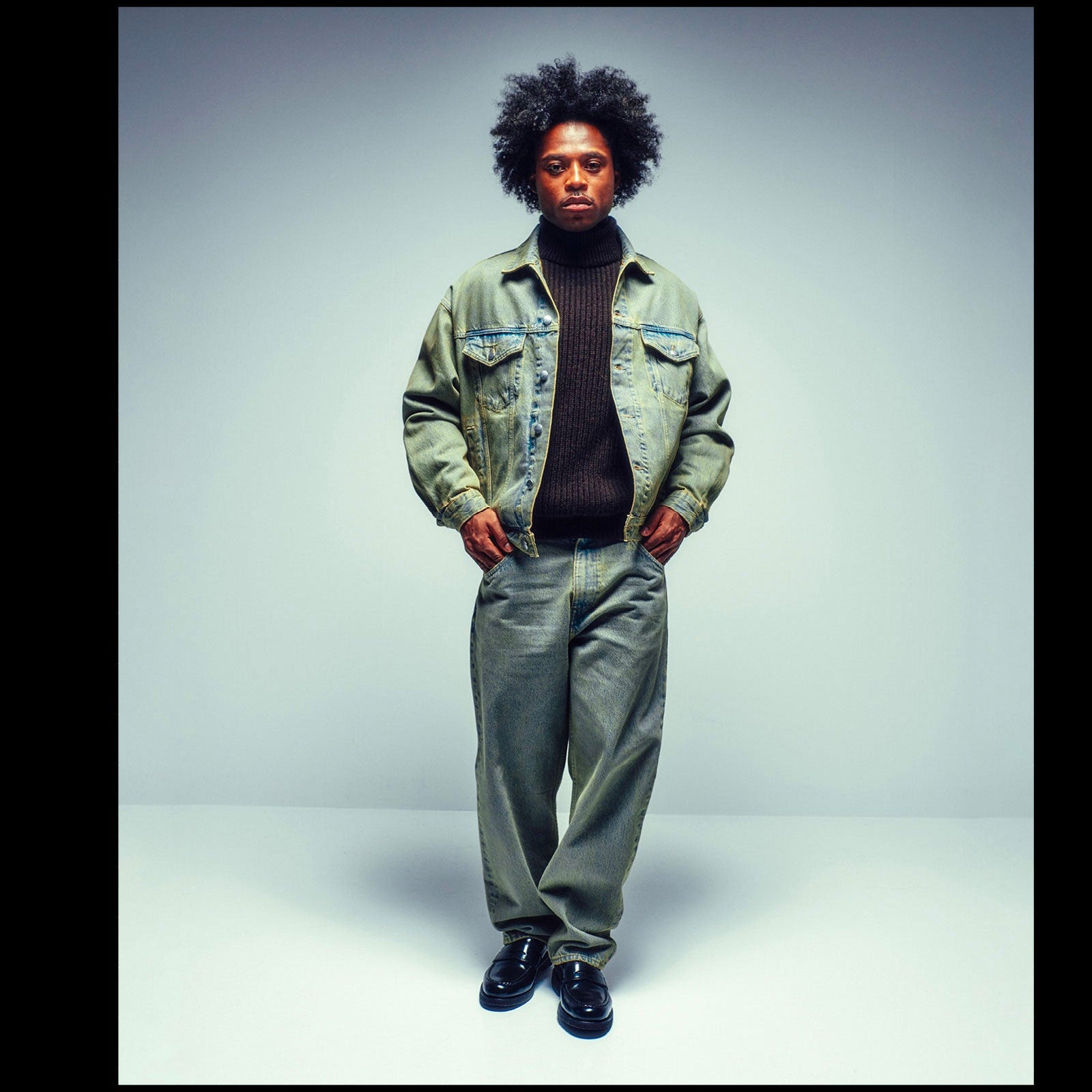
There are now also modified techniques, such as mud washing/dying or sand washing , mud dyeing and sandblasting of denim, which gives the products a dirty, worn look, but less chemical and more organic look.
Acid Wash: A similar process to stonewashing, except that pumice stones and chlorine are used to create a very light blue, almost white look. This method originated or was copied from the surfer and counterculture of the 1980s, whose Levi's 501 jeans were dyed light by the salt water of the ocean and drying in the blazing sun. Punk culture of the 1980s adopted this stylistic device, with skinheads and punks spraying batlle jackets and jeans with chlorine bleach to create a high-contrast, speckled fade reminiscent of camouflage.
Undyed Cotton/Natural: Cotton (and the resulting yarn) are not white, as is often assumed, but are actually naturally light brownish-beige, a more natural, impure white. Bleaching the finished yarn creates the familiar pure white cotton thread.
But denim can also be made from untreated, undyed cotton. The finished products retain the natural, organic look of the undyed raw material.
We hope this short guide has shed some light on the denim jungle. For detailed advice on trousers and especially jeans, feel free to stop by our store or drop us a line!